
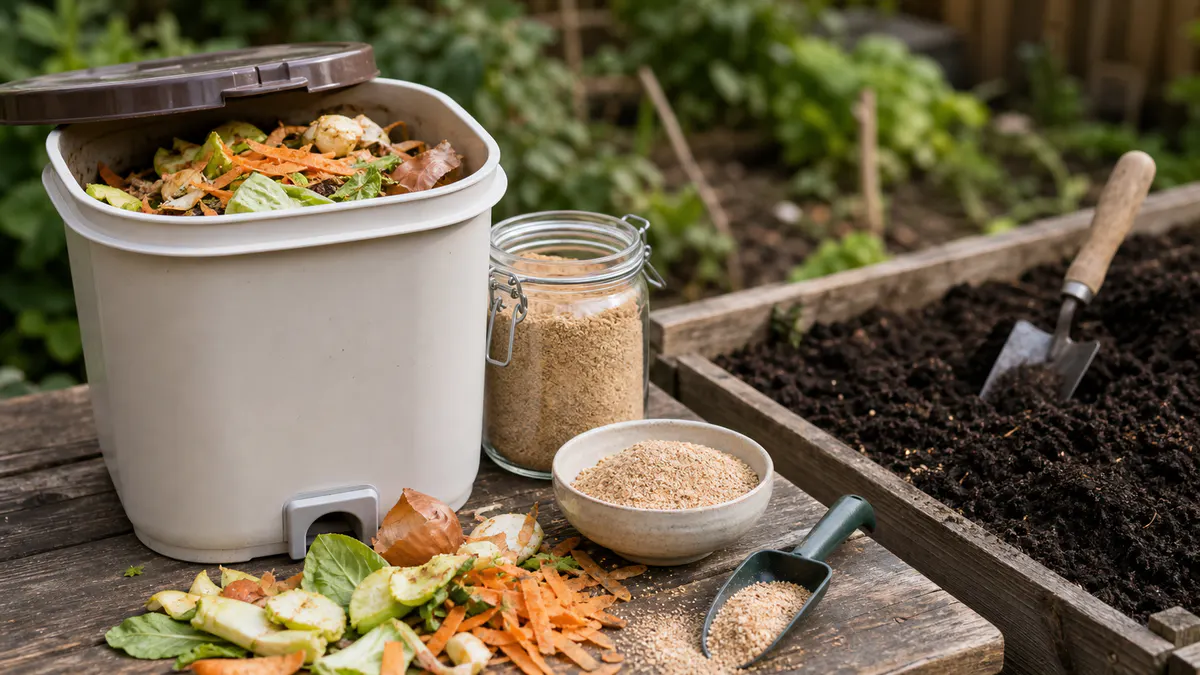
Bokashi may feel like a fairly new idea, especially if you have only recently come across bokashi bins, bokashi bran or kitchen waste fermentation. But the thinking behind bokashi is much older than the neat little buckets now sold for homes, gardens and allotments.
At its heart, bokashi is part of a long human tradition: using fermentation, microbes and organic matter to preserve nutrients and return fertility to the soil.
Today, bokashi is often described as a Japanese composting method. More accurately, it is a fermentation method that prepares food waste and other organic materials so they can be returned to the soil more easily. The modern household bokashi system became widely known through the work of Professor Teruo Higa in Japan in the 1980s, particularly through his development of Effective Microorganisms, often shortened to EM.
But the wider story of bokashi reaches further back than one person, one product or one country.
What Does Bokashi Mean?
The word bokashi is Japanese and is commonly translated as something like “fermented organic matter”. In gardening and soil care, it usually refers to organic material that has been fermented with the help of beneficial microorganisms.
This is an important starting point because bokashi is often confused with composting.
Traditional composting is mainly a process of decomposition. Garden waste and food scraps break down with the help of oxygen, moisture, bacteria, fungi, worms and other organisms.
Bokashi is different. It is based on fermentation. Food waste is sealed away from air and treated with a microbial inoculant, usually bokashi bran. Rather than rotting, the food waste ferments. Once this fermented material is buried in soil or added to compost, soil organisms can finish the process.
So although people often call it “bokashi composting”, it is really more like pre-composting through fermentation.
Ancient Roots: Fermentation, Farming and Soil
Long before modern bokashi buckets existed, people all over the world were using fermentation to preserve food, manage waste and support agriculture.
Fermentation is one of humanity’s oldest biological tools. It gave us foods such as yoghurt, sauerkraut, kimchi, sourdough, miso, tempeh and pickles. These foods depend on communities of microbes transforming raw ingredients into something more stable, digestible or long-lasting.
It is not hard to see how the same thinking connects to soil.
Farmers and gardeners have always watched what happens when organic matter is mixed with earth, buried, soaked, fermented or composted. Before synthetic fertilisers became common, fertility came from local cycles: manure, crop residues, leaf mould, animal bedding, kitchen scraps, seaweed, green manures and composted plant material.
In parts of Asia, fermented organic materials have long been used in farming traditions. Some accounts link bokashi-like practices with older Korean and Japanese agricultural methods, where farmers fermented organic waste or used locally gathered microorganisms to support soil fertility. However, the exact ancient origins of bokashi are not always clearly documented, so it is best to treat those claims with a little caution. What we can say with confidence is that bokashi belongs to a much wider tradition of microbial, fermented and low-waste agriculture.
Traditional Soil Wisdom Before Chemical Fertilisers
For most of farming history, people had to be extremely careful with nutrients.
If a household threw away food scraps, ashes, bedding, manure or plant residues, they were throwing away future fertility. Organic matter was precious. It fed animals, soil, crops and communities.
In many traditional systems, there was no sharp line between “waste” and “resource”. What left the kitchen could return to the garden. What came from the animal shed could return to the field. What fell from trees could become mulch or leaf mould.
Bokashi fits beautifully into this older way of thinking.
It asks us to stop seeing food scraps as rubbish and start seeing them as part of a living cycle. A banana skin, onion peel or leftover rice still contains nutrients. Bokashi simply offers a way to hold onto those nutrients and return them to soil life.
That is why bokashi feels both modern and ancient. The bucket may be modern, but the mindset is old: waste less, cycle nutrients, feed the soil.
The Modern Bokashi Method
The modern bokashi system most people know today is closely linked to Professor Teruo Higa, a horticultural scientist from Okinawa, Japan. In the 1980s, Higa developed and promoted a blend of microorganisms known as Effective Microorganisms, or EM. These microbial blends typically include groups such as lactic acid bacteria, yeasts and photosynthetic bacteria.
Originally, EM was developed for agricultural use, with the aim of supporting soil fertility and reducing reliance on chemical fertilisers and pesticides. From there, EM-based products spread into different areas, including farming, gardening, waste treatment and household bokashi systems.
The modern household method is simple:
Food waste is added to an airtight bucket.
Bokashi bran is sprinkled between layers.
The waste is pressed down to remove air.
The bucket is sealed and left to ferment.
The fermented material is then buried in soil, added to compost or mixed into a soil factory.
This made bokashi especially attractive for households because it could deal with food waste in a compact, low-odour way. Unlike a traditional compost heap, it could be used indoors, in small gardens, on balconies, in sheds or by people with limited outdoor space.
Why Japan Was So Important in the Bokashi Story
Japan has a rich history of fermentation. Fermented foods such as miso, soy sauce, rice vinegar, sake, pickles and fermented vegetables are deeply woven into Japanese food culture.
This matters because bokashi is easier to understand when you see it as part of a wider fermentation culture.
Fermentation is about working with microbes rather than against them. It is about creating the right conditions so beneficial organisms dominate and unwanted rotting is reduced. That idea applies just as much to bokashi as it does to fermented foods.
The modern Japanese bokashi method took this microbial thinking and applied it to organic waste and soil care. Instead of letting kitchen scraps rot in a bin, the bokashi method ferments them in a sealed container. The aim is to stabilise the material and prepare it for the soil.
It is simple, but quite clever.
Bokashi and Effective Microorganisms
Effective Microorganisms, or EM, became central to the global spread of bokashi.
EM is a trademarked term associated with microbial products developed through Higa’s work. These products are based on mixtures of commonly occurring microorganisms, including lactic acid bacteria and yeasts.
In bokashi, these microbes are usually applied through bokashi bran. The bran acts as a carrier. It may be made from wheat bran, rice bran, sawdust or similar dry material, combined with molasses and the microbial inoculant. When sprinkled onto food waste, it helps start the fermentation process.
Lactic acid bacteria are especially important because they are associated with sour fermentation. They help create acidic conditions, which discourage putrefying organisms and give bokashi its characteristic pickled smell.
This is why a healthy bokashi bucket should smell sour, tangy or fermented, not rotten.
The Spread of Bokashi Around the World
After its development and promotion in Japan, bokashi gradually spread around the world. EM-based methods were taken up in parts of Asia, Latin America, Europe and beyond. Some sources describe EM and bokashi methods reaching many countries, with household bokashi becoming especially popular among gardeners, urban composters and sustainability-minded households.
The appeal is easy to understand.
Bokashi suits modern life in a way that many compost heaps do not. It is compact. It can be used indoors. It can handle cooked food. It does not require turning. It can process many things that people are often told not to put into ordinary compost bins, such as small amounts of dairy, meat, fish, bread, rice and plate scrapings.
For people living in towns and cities, this was a big shift.
You did not need a big garden to start recycling food waste. You could begin with a bucket under the sink.
Bokashi in the Home Composting Movement
As more people became interested in reducing waste, cutting landfill, growing food and improving soil, bokashi found a natural place in the home composting movement.
Traditional composting is wonderful, but it can be awkward for some households. Compost heaps need space, air, moisture and a balance of materials. They can also attract pests if food waste is added carelessly.
Bokashi offered a different route.
Because the waste is sealed inside a bucket, it is less likely to attract flies or rodents during the fermentation stage. Because it ferments rather than rots, it can be much less smelly when managed properly. Because it accepts cooked food scraps, it deals with a larger proportion of real household food waste.
This made bokashi particularly popular with:
Urban gardeners
Allotment holders
People with small gardens
Balcony growers
Families wanting to reduce food waste
Schools and community gardens
Eco-conscious households
Gardeners interested in soil biology
It became less of a specialist farming method and more of a practical household soil-care tool.
Bokashi and the Rise of Soil Health Thinking
In recent years, interest in soil health has grown enormously. Gardeners and growers are no longer only asking, “What fertiliser should I add?” They are asking deeper questions.
How do we feed soil life?
How do we build organic matter?
How do we reduce waste?
How do we support worms, fungi and microbes?
How do we grow in a way that works with nature?
Bokashi fits neatly into this shift.
It is not just about getting rid of food waste. It is about seeing food scraps as part of the soil food web. Once fermented and added to soil, bokashi becomes food for bacteria, fungi, worms and other soil organisms. Over time, this can contribute to organic matter and nutrient cycling.
Bokashi is not a magic fix, and it should not be oversold as one. It works best as part of a wider soil-care approach that may include compost, mulch, leaf mould, green manures, cover crops, worm composting, no-dig methods and diverse planting.
But as one tool in the soil health toolkit, it has a valuable role.
Bokashi, Science and Sensible Claims
The history of bokashi is also a reminder to be sensible with claims.
Some bokashi and EM products have been marketed with very broad promises. Scientific views on EM can be mixed, especially when claims go beyond waste fermentation and into wider assertions about plant growth, yield or disease control. Some studies and reviews have questioned whether the special microbial blends themselves always produce the dramatic benefits claimed, separate from the value of adding nutrient-rich organic matter.
For a soil-friendly gardener, this does not mean bokashi has no value. It simply means we should describe it honestly.
Bokashi is useful because it helps ferment food waste, reduce odour when done properly, and return organic matter and nutrients to soil. Those are strong enough reasons to use it without needing to claim it solves everything.
The best way to think about bokashi is practical and grounded:
It helps keep food waste out of the bin.
It makes kitchen scraps easier to handle.
It preserves nutrients for the soil.
It supports a circular approach to growing.
It works well alongside composting, wormeries and soil-building practices.
That is where bokashi really shines.
Bokashi Today
Today, bokashi is used by people all over the world, from home gardeners with a bucket under the sink to community composting projects and small-scale growers.
Its modern popularity comes from a mixture of old wisdom and modern need.
We live in a world where food waste is a serious issue. Many soils are depleted of organic matter. Many people want to garden more sustainably but do not have large outdoor spaces. Bokashi answers several of these problems in a very simple way.
It says: keep the nutrients cycling.
Do not waste what can feed the soil.
Let microbes help.
Think of the kitchen and garden as one connected system.
That is a beautifully Soilistry way of seeing the world.
A Quietly Radical Idea
The history of bokashi is not just the history of a composting bucket. It is the history of a different relationship with waste.
Modern life often teaches us to throw things away and forget about them. Bokashi asks us to pause and look again.
Food scraps are not the end of the story. They are the beginning of another one.
Through fermentation, burial, soil life and plant growth, yesterday’s leftovers can become tomorrow’s fertility. That idea is old, practical and quietly radical.
Bokashi may have become widely known through Japanese innovation in the 1980s, but it belongs to a much bigger story: the human story of working with microbes, respecting organic matter, and returning life to the soil.
Final Thoughts
Bokashi is both ancient in spirit and modern in form.
Its roots sit among traditional farming, fermentation and nutrient cycling. Its modern household version developed through the work of Professor Teruo Higa and the spread of Effective Microorganisms in Japan from the 1980s onwards. Today, it has become a simple tool for anyone who wants to reduce food waste and care for soil at home.
For gardeners, bokashi is a reminder that soil care does not always need to be complicated.
Sometimes it starts with a bucket, a handful of bran, a few kitchen scraps and a decision to see waste differently.
Bokashi brings the cycle home: from food, to scraps, to fermentation, to soil, to life.